

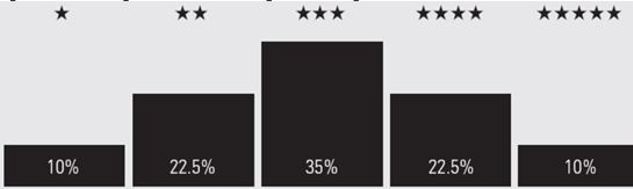
If Morningstar awards 5 stars, this means that the portfolio is among the top 10 per cent in its category, whilst 1 star indicates that the portfolio is among the bottom 10 per cent.
LD Shares & Bonds, which accounts for almost 100 per cent of the main LD Discretionary fund, has consistently ranked at the very top with a 5-star rating for most months over a period of several years. This places it in the top decile.
Morningstar uses at least three years’ of historical data when assessing individual portfolios.
On the ‘Return and risk’ page, the column on the right provides an overview of the ratings – i.e. the number of stars – for the five investment funds.
Portfolio ratings
In the links below, you can click on a portfolio to view Morningstar’s more detailed assessment of each portfolio, including further information on risk.
Morningstar is unable to rate LD Discretionary, as this portfolio contains unlisted assets in addition to its listed investments. However, LD Aktier & Obligationer, described below, accounts for 99.7% of LD Discretionary.
LD Shares & Bonds (LD Discretionary)
LD Bonds (formerly LD Mixed Bonds)
On the Morningstar website, you can find explanations under ‘Methodology’.
Below, we provide some explanations of some of the terms.
-
It measures the risk-adjusted return and is typically calculated as the excess return relative to the risk-free rate, measured against the standard deviation of the excess return. In other words, the higher the Sharpe Ratio, the better the investment has performed.
-
Morningstar uses the R-squared risk metric to measure the proportion of a fund’s volatility that can be explained by market volatility. R-squared ranges from 0 to 100 per cent, and 100 per cent means that the fund’s volatility can be fully explained by market volatility, whilst, for example, an R-squared of 35 per cent indicates that 35 per cent of the volatility is attributable to market volatility. The higher the R-squared value, the more reliable the alpha and beta indicators are.
-
Beta is a method for determining a portfolio’s sensitivity to fluctuations in its market. Morningstar calculates the risk measure known as beta by comparing the portfolio’s performance over the past 36 months with that of a specified market index. A beta of 1.00 means that the portfolio moves in exactly the same way as the market. A beta of less than 1.00 means that the portfolio is less affected by market events than the market itself. If the beta is above 1.00, the portfolio’s value fluctuates more than the market, which means that if the market rises, the portfolio rises more, and if the market falls, the portfolio falls even more.
-
Morningstar calculates alpha over the last 36 months. Alpha measures the portfolio’s actual performance relative to its expected performance, as indicated by beta. A positive alpha means that the portfolio has outperformed expectations given the risk measured by beta. A negative alpha means the opposite.
Allocation of portfolios at Morningstar
Morningstar carries out a monthly rating of the portfolios, awarding up to five stars based on the distribution of the portfolios within each group, as shown in the figure below.
Morningstar assesses the portfolios in The Cost-of-Living Allowance Fund on the same terms as it assesses comparable investment products in Europe. This means, amongst other things, that the portfolios can be compared with several hundred investment fund sub-funds offered by Danish investment funds.
A top rating of five stars therefore means that the portfolio is ranked in the top tenth, which must be regarded as highly satisfactory. Four stars can be described as very satisfactory, whilst three stars are satisfactory.
-
Morningstar assesses the funds based on a range of criteria relating to return, risk and costs, and awards them between 1 and 5 stars depending on how well each fund has performed. The rating is a weighted average of the portfolio’s performance over three- and five-year periods and is updated by Morningstar once a month.
-
Each fund is categorised, based on its investment universe, into a group of comparable European funds. Returns are analysed over a minimum period of three years, supplemented where possible by returns over five and ten years. Long-term returns are given greater weight than short-term returns.


