

From 1988 to 2004, Flemming Skov Jensen headed Dyrtidsfonden. Dyrtidsfonden established its reputation as a patient, long-term investor, keen to collaborate with business owners and senior executives to create new industries and jobs. At the same time, however, he remained firm in his belief that Dyrtidsfonden should not invest in projects with no prospects, and in this way helped to ensure good returns for its members.
Flemming Skov was not a timid man. He defended the fund’s decisions, even when they backfired. According to a business publication, he came away with a black eye when an attempt to rescue Hafnia ended in a heavy loss. In other cases, the results were substantial gains, such as nearly a billion from the sale of the IT company Giga to Intel in 2000.
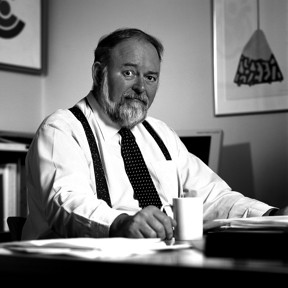
Flemming Skov Jensen was director of Dyrtidsfonden (now LD Pensions) from 1988 to 2004.
Photo: Søren Nielsen
He had the courage to bring people on board for board work, even though they had been sacked from a senior position just a few months earlier. He acted on his instinct for people and accelerated the process of matching board candidates with companies. He launched one of the first board training programmes for both employee-elected and shareholder-elected board members.
Flemming Skov had a flair for politics and a sense of humour. At a meeting about the foundation’s work, he presented Kristian Thulesen Dahl with a tin of butter biscuits. The biscuit tin had been specially ordered for the occasion and bore the name ‘Kjeldsen’, even though the company had switched to the more international name ‘Kelsen’. The gift symbolised the foundation’s long-standing commitment to Danish businesses, including the biscuit manufacturer from Kristian Thulesen Dahl’s home region.
The computer was always left on in the office, but one of the reasons for this was to enable him to take part in auctions for stamp collections. He was a die-hard philatelist and steadfastly insisted that letters from the foundation should bear genuine stamps. Interrupting Flemming Skov during an important auction could prove detrimental to one’s career in the short term. But Flemming Skov was also a leader who stood by his staff and encouraged innovative thinking and courage in their investment work.
When, in the early 1990s, Flemming Skov called on Danish companies to maintain a high standard of transparency and strike a good balance with their local communities, it was just as unheard of as it is now entirely commonplace. Over time, Flemming Skov’s approach to corporate governance has become a classic, even though that was not what he was aiming for, nor was it something those around him expected. He was a pioneer in active ownership and social responsibility in investment – things that are now absolute requirements for major investors.
May his memory be honoured.

