G6A6663 Lars

2023 was a good year for investments, and we are delighted to be able to offer all our members a high return.

The negative return in 2022 has been more than offset by the positive performance in 2023, and unlike many comparable funds, our members now have a positive return overall for the past two years.

On this page, you can find a more detailed overview of the results for 2023 and our expectations for 2024.

Lars Mayland Nielsen
Director of LD Pensions
  • Explanation of the strong returns in 2023

    In 2023, economic performance was far better than expected. As a result, your holiday allowance funds grew by 10.1% in return.

    Equities, credit and bonds all contributed to making 2023 a good year for investment, delivering a high return for you as a member. And with a return of 10.1%, the negative return of -7.9% in 2022 was more than made up for. The return is after pension return tax and costs.

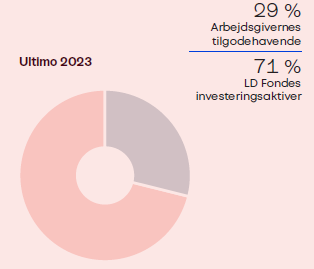
    The result was driven in particular by investment assets, which yielded a return of 13.1%. The Holiday Allowance Fund comprises an investment portfolio consisting of investment assets and a receivable from employers who have retained holiday allowance within their companies. The receivables from employers yielded a return of 4.7% and accounted for 29% of total assets at the end of the year, compared with 32% at the start of the year.
    Financial developments in 2023

    Concerns about persistently high inflation and a severe economic downturn gave way to growing optimism as the year progressed. Inflation returned to near-normal levels, the labour market remained exceptionally strong in the US, and the global economy saw solid growth. Geopolitical tensions characterised 2023, with the war in Ukraine continuing and the conflict between Israelis and Palestinians reigniting fiercely, but these tensions had no significant impact on the financial markets.

    Interest rate trends were one of the biggest challenges facing the financial markets in 2023. In the third quarter, interest rate rises caused the stock markets to fall quite sharply amid fears that private consumption and corporate earnings would be adversely affected. In the fourth quarter, these fears were replaced by positive expectations that interest rates would not rise any further – perhaps even the opposite – and that consumers and businesses would be able to cope with the current level of interest rates. We therefore saw a very positive trend in the equity markets towards the end of 2023. The trend in interest rates also benefited the bond markets, which have likewise contributed to healthy returns.

  • How do we invest your holiday allowance funds?

    Your return depends on developments in the financial markets and may be either positive or negative. However, your holiday allowance funds are invested with the aim of generating the highest possible return, whilst taking into account the risk of loss.

    We invest with the overarching aim of safeguarding our members’ interests as effectively as possible. In practice, this is achieved by estimating the long-term return within certain parameters for short-term and long-term risk of loss. We estimate what proportion of members’ assets employers retain within their organisations, and set investment limits for the portion of the assets that is invested.

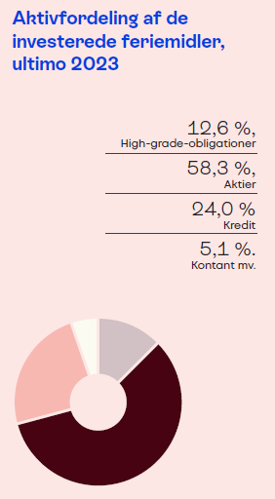
    In relation to the portion of the funds we invest, the asset allocation at the end of 2023 was as follows:

    We are committed to addressing the social and climate-related impact of our investments. You can read more about our work on responsible investment here.

  • How has your return on investment fared since the start?

    With an attributed return of 10.1% in 2023, we made up for the negative return from 2022. And, unlike many comparable funds, members now have a positive return overall for the past two years.

    From the time your frozen holiday allowance funds were released until the end of 2023, you have received a total return of 6.1%. This result should be viewed in the context that only a small proportion of the funds could be invested at the start of the period. Currently, approximately 70 per cent of members’ assets are invested, whilst approximately 30 per cent are held by employers. 

    In 2021, a positive return of 4.6% was recorded; the return in 2022 was -7.9%, and in 2023, as mentioned, we achieved a return of 10.1%.

    In 2023, we continued our work on optimising the investment portfolio. The return on investment assets was slightly lower than the benchmark in 2023. This was partly because the proportion of technology shares in our equity portfolio was slightly lower than in the benchmark in 2023, when returns on technology shares were particularly high. The equity strategy aims to generate long-term excess returns, and since its launch in 2021, the current strategy has delivered a higher return than the benchmark.

    You can view the current return here.

    You can view your personal figures by logging in to the self-service portal on borger.dk here.

  • A savings scheme with a unique structure

    Your savings in the Employees' Holiday Allowance Fund have a unique structure, as just under a third of the frozen holiday allowance is held by employers.

    Employers are permitted to retain a portion of the holiday allowance funds within their organisations. Employers pay an indexation charge in order to retain the holiday allowance funds as liquidity. LD Pensions recognises this indexation as part of the return accruing to members.

    Employer-provided holiday allowance funds provide stability for your savings by protecting them against losses and by generating returns in line with general wage growth. This also means that the majority of the funds we invest ourselves (the investment assets) consist of higher-risk assets, which over time should generate higher returns than the index-linked funds held by employers. Overall, this should provide members with satisfactory returns whilst maintaining a balanced level of risk.  

    It is a financial advantage for members that no pension returns tax is payable on the indexation of holiday allowance funds held by employers. Had this portion instead consisted of investments in bonds, pension returns tax would have been payable on the returns.

    It makes no difference to your return whether your employer has chosen to retain the holiday allowance within the company or has paid it into the Employees' Holiday Allowance Fund. The returns on both the funds held by employers and the invested Holiday Allowance funds are distributed in such a way that everyone receives the same percentage allocation to their savings.


Low costs

The costs of keeping your frozen holiday allowance funds as a savings account with us are very low. In fact, they are lower than with most other savings options.

In 2023, we in LD Pensions charged just 0.04% to manage your savings. Total direct and indirect investment costs amounted to just 0.30%. This works out at a total of approximately 0.34% in annual costs.

Low costs mean your savings grow in value. This is because only a small portion of the Return is deducted to cover costs.

Your very own savings account

On the day your frozen holiday allowance is paid out, you will receive a single lump sum which you are free to use as you wish.

Most people become eligible for payment upon reaching state pension age, but this can also happen earlier in connection with permanent withdrawal from the labour market.

Your savings can remain in the scheme for as long as you wish, even after you have become eligible for payment. It can serve as a kind of financial reserve or buffer, which can grow whilst you wait until you need it.

We are constantly working to optimise how we invest members’ accrued holiday allowance funds to ensure the best possible long-term return for our members.

In 2023, for example, we have decided to invest up to DKK 2 billion in alternative investments via listed investment companies. Investing in alternative investments via the stock markets is a new development in Denmark. With this investment, we expect to be able to increase precisely that long-term return.

Kristoffer Fabricius Birch

Head of Investments in LD Pensions

A soft landing for the economy in 2024?

Following a couple of years of high inflation and interest rate rises, the financial markets are expected to be characterised by monetary policy easing in 2024 due to the prospect of lower inflation. Here at the start of 2024, several factors point to a soft landing for the economy in 2024 and therefore, overall, the basis for positive, albeit slightly lower, returns than the strong performance seen in 2023.

The monetary policy tightening implemented in 2023 is having a delayed impact on the economy and is expected to continue to dampen growth to some extent in 2024. Conversely, consumers can look forward to an increase in real wages as a result of significant pay rises and the prospect of low inflation. Consumption is supported by the fact that the labour market remains strong in both Europe and the US, and there are prospects for increased investment, driven in part by companies’ increased focus on securing their own supply chains, as well as government support packages, particularly for the green transition.

However, significant risks could have a negative impact on the financial markets in 2024. The war in Ukraine continues, the conflict in Gaza has flared up again, and attacks on merchant ships in the Red Sea are threatening key trade routes. China faces challenges from a debt-ridden property sector and changing global trade patterns, and there are tensions between China and Taiwan. There are also risks related to inflation trends. Persistently high core inflation may mean that central banks have to disappoint market expectations of interest rate cuts. This could contribute to lower economic growth and lead to capital losses across asset classes.

2024 could therefore be another year of significant volatility in the financial markets.

The above assessment of the economic outlook for 2024 is based on financial market indicators from January 2024. In LD Pensions, we monitor developments and revise our forecasts when warranted. Keep up to date with our market commentary under ‘News’ at ld.dk.

It’s reassuring to have a financial buffer in your personal finances. Accrued holiday allowance funds are one such buffer, and the fact that their value increases over time through Return only makes them better.

On the day you reach state pension age, you are free to choose for yourself when to withdraw the funds and for what purpose.

Else Nyvang

Managing Director of LD Pensions

Why do I even have a savings account for holiday allowance funds?

All employees who accrued holiday pay between September 2019 and August 2020, and who have chosen to leave their frozen holiday allowance in place, have savings with The Holiday Allowance Fund.

One year’s worth of accrued holiday pay was frozen following the introduction of a new holiday pay law in 2020. The intention was that the frozen holiday allowance would constitute a pension sum that would be paid out when the individual employee reached state pension age. However, following the outbreak of Covid-19, the Danish government sought to stimulate the economy. A key measure in this regard was the early payout of the frozen holiday allowance. All employees were given two opportunities for payouts of their new savings from the Employees' Holiday Allowance Fund.

If you have savings with The Holiday Allowance Fund, it is therefore because you have chosen not to have all your accrued holiday allowance funds paid out, but have opted to keep them in a savings account with us instead.

At home, we’re actually working on increasing our pension savings right now, so that we’ll be able to retire earlier. By the time it’s our turn, the retirement age may well have risen even further.

That’s why we’re making a point of putting extra money aside. And that also played a part in my decision to leave the frozen holiday pay untouched.

Louise

Consultant at an IT company

Nyheder

See all news
Positive returns in both funds

Following a challenging start to 2026, positive returns are once again the hallmark of members’ returns at LD Pensions.

Read more om Positive returns in both funds
Geopolitical turmoil has characterised the first quarter of the year

A challenging first quarter, characterised by geopolitical tensions and rising energy prices, has given way to a more positive market trend in April, and returns are now positive once again.

Read more om Geopolitical turmoil has characterised the first quarter of the year
LD Pensions promotes active ownership

A new partnership with Federated Hermes EOS strengthens LD Pensions’ work on active ownership.

Read more om LD Pensions promotes active ownership
Created with sketchtool. Created with Sketch. Created with sketchtool. Created with Sketch. Created with Sketch. Created with Sketch. Created with sketchtool. Created with sketchtool. Created with sketchtool. Created with sketchtool. Created with sketchtool. Created with sketchtool. Created with sketchtool. Created with sketchtool. Created with Sketch. Created with sketchtool. Created with sketchtool.